
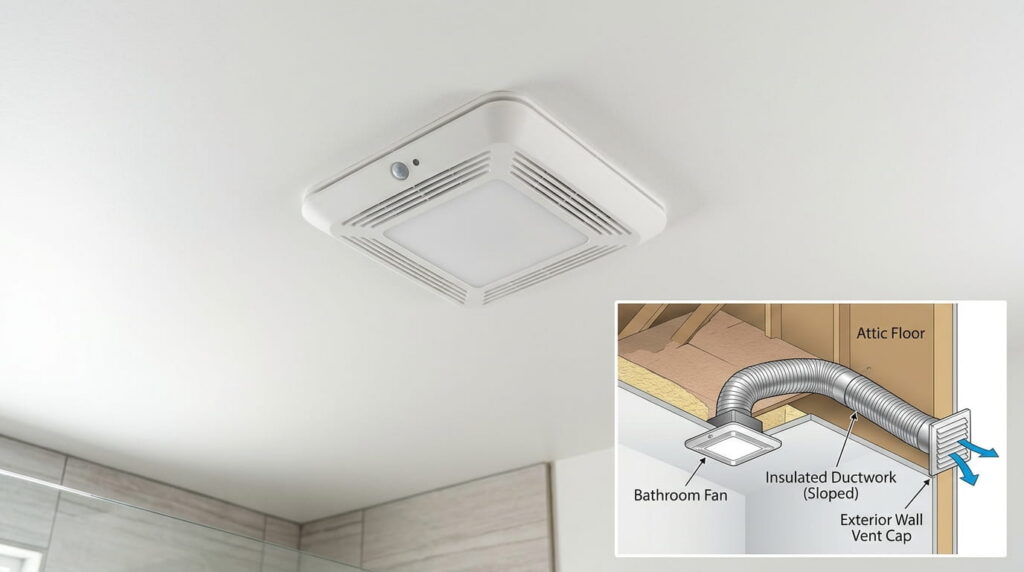
A bathroom exhaust fan is one of the most important mechanical systems in your home. It removes moisture, odors, and pollutants that damage finishes and harm indoor air quality. Yet many homeowners overlook it until mold appears or paint peels.
Colorado’s dry climate creates a false sense of security. Shower steam creates localized humidity that must be exhausted, regardless of the outdoor humidity level. A properly sized and installed bathroom exhaust fan protects your home’s structure and your family’s health. This guide explains the code requirements, sizing formulas, and installation rules for Aurora and the Front Range.
Why Bathroom Ventilation Matters in Colorado
Bathrooms generate more moisture than most homeowners realize. A long hot shower can quickly raise relative humidity to levels that promote mold, rot, and finish failure. Even in a dry climate, the moisture concentrates in the bathroom and finds its way into walls, ceilings, and framing.
Modern Colorado homes feature tight building envelopes designed for energy efficiency. However, these tight envelopes can trap humidity if local exhaust and whole-house ventilation are not sized and installed correctly.
The consequences of poor ventilation include peeling paint, cracked drywall, mold growth, and structural rot. In winter, moisture condenses on cold surfaces like windows and exterior walls. Over time, that condensation creates a breeding ground for mold.
Code Requirements for Bathroom Exhaust Fans
Current residential codes and ventilation standards, including the International Residential Code and ASHRAE 62.2, set specific minimum requirements. A bathroom exhaust fan must provide at least 50 CFM (cubic feet per minute) for intermittent use or roughly 20 CFM for continuous operation.
The IRC specifically requires a minimum ventilation rate of 50 CFM intermittent or 20 CFM continuous for bathrooms. This baseline applies to typical toilet and shower rooms. However, it is only a floor, not a target.
Most areas require a ventilation system if the bathroom has no window. Even when a window exists, current codes strongly encourage mechanical ventilation in all bathrooms. A window alone does not provide reliable moisture removal, especially during winter when windows stay closed.
Sizing Your Fan: Beyond the Code Minimum
A 50 CFM fan meets code minimums for a small bathroom, but it may not provide adequate moisture control. Proper sizing depends on the room’s volume and the desired air changes per hour.
Use this formula: required CFM = (room length × width × ceiling height) × desired air changes per hour ÷ 60. For fast steam clearance after a shower, target 8 to 10 air changes per hour.
For a 10 foot by 8 foot room with 8 foot ceilings, that means roughly 85 to 110 CFM, not 50. A standard 5 by 8 foot bathroom needs 50 to 80 CFM. A larger master bathroom, 8 by 12 feet, needs 80 to 110 CFM.
Bathrooms with jetted tubs or separate toilet rooms may require higher capacity fans. Always choose a fan with extra capacity to account for duct resistance.
Duct Sizing and Installation Rules
The fan’s performance depends on the ductwork. Long duct runs, multiple elbows, in-line dampers, and roof or sidewall terminations can reduce delivered airflow by 20% to 30% or more.
Use smooth metal ducting sized to the fan, typically 4 inch or 6 inch. Keep runs short and straight. Insulate ducts that pass through cold attics to prevent condensation inside the duct.
Select a fan whose rated flow will still meet the minimums when installed, accounting for static pressure from the duct run. Look at the manufacturer’s performance curve at actual static pressure rather than the free-air CFM number.
Put the fan as close to the showerhead as possible. This placement captures steam at the source before it spreads throughout the room.
Exterior Venting: The Non-Negotiable Rule
Colorado building codes prohibit bathroom exhaust fans from venting into attics, crawlspaces, or soffits. Moisture causes mold, rot, and insulation damage in these concealed spaces.
The bathroom exhaust fan must vent directly to the building exterior through a roof or wall cap with a damper. Denver and Fort Collins inspectors enforce this requirement at final inspection.
Proper vent termination includes a backdraft damper to prevent cold air infiltration during Colorado winters. Install screening to prevent pest entry. Attic venting was common in older homes, but current codes require exterior termination to prevent moisture problems.
Choosing the Right Fan for Your Home
Selecting a bathroom exhaust fan involves more than checking the CFM rating. Consider these factors for optimal performance.
Noise level. Choose quiet models with low sone ratings, near or below 1.0 sone. Quieter fans encourage regular use, which is essential for moisture control.
Controls. Prefer units with humidity sensors or timers. These ensure adequate runtime after showers, automatically running until moisture levels normalize.
Energy efficiency. Modern energy-efficient fans use 15 to 40 watts and cost only $15 to $30 annually to operate, even with extended run times.
Whole-house ventilation. In tight custom homes, an ERV or HRV can provide balanced whole-house ventilation and help manage indoor humidity year-round while preserving energy efficiency.
Maintenance and Longevity
A bathroom exhaust fan requires minimal maintenance, but neglect reduces performance. Clean the fan grille every few months to remove dust and lint. Dust buildup restricts airflow and strains the motor.
Listen for unusual noises. A rattling or grinding sound indicates a loose part or a failing bearing. Replace the fan if performance drops noticeably.
Run the fan for 20 to 30 minutes after every shower. This duration completely removes moisture and prevents mold growth. A timer switch or humidity sensor automates this process, removing the burden from the homeowner.
Why Aronov Construction for Bathroom Ventilation
Aronov Construction LLC brings more than 20 years of residential experience to every bathroom remodel. We size bathroom exhaust fans correctly, install smooth metal ducting, and terminate all exhaust to the exterior. We correct improperly vented fans from older installations and ensure your bathroom meets current Colorado codes.
We provide clear scopes, fixed-price budgets, and dedicated supervision. Contact us today to schedule a ventilation assessment for your Aurora home.
Frequently Asked Questions
1. What is the code requirement for a bathroom exhaust fan in Colorado?
The IRC and ASHRAE 62.2 require a minimum of 50 CFM for intermittent use or 20 CFM for continuous operation. Colorado jurisdictions enforce these minimums and require exterior venting.
2. Can a bathroom exhaust fan vent into the attic in Colorado?
No. Colorado building codes prohibit venting into attics, crawlspaces, or soffits. Moisture causes mold, rot, and insulation damage. The fan must vent directly to the exterior through a roof or wall cap.
3. How many CFM do I need for my bathroom fan?
Use the formula: (room length × width × ceiling height) × desired air changes per hour ÷ 60. For fast steam clearance, target 8 to 10 air changes per hour. A 10 by 8 foot bathroom needs roughly 85 to 110 CFM.
4. How long should I run my bathroom fan after a shower?
Run the fan for 20 to 30 minutes after a shower to completely remove moisture. A timer switch or humidity sensor fan automates this process and ensures adequate runtime.
5. Do I need an exhaust fan if my bathroom has a window?
Yes. Most areas require a ventilation system if there is no window. Even with a window, current codes strongly encourage mechanical ventilation because windows do not provide reliable moisture removal, especially in winter.
6. What size duct should I use for a bathroom fan?
Use smooth metal ducting sized to the fan, typically 4 inch or 6 inch. Keep runs short and straight. Insulate ducts that pass through cold attics to prevent condensation.
7. Why is my bathroom fan so loud?
Noise comes from the motor, vibration, or undersized ductwork. Choose a fan with a low sone rating, near or below 1.0 sone. Quieter fans encourage regular use, which improves moisture control.
8. How much does it cost to run a bathroom fan?
Modern energy-efficient fans use 15 to 40 watts and cost only $15 to $30 annually to operate, even with extended run times. The cost is minimal compared to the damage caused by excess moisture.
9. Can I install a bathroom fan myself?
Installing a bathroom fan requires electrical work, duct routing, and exterior termination. Improper installation creates fire hazards, moisture problems, and code violations. Hire a licensed contractor.
10. How do I know if my bathroom fan is working properly?
Hold a piece of toilet paper near the grille. If it sticks, the fan is drawing air. If it falls, the fan is not moving enough air. Clean the grille and check the duct for blockages.
Final Thoughts
A bathroom exhaust fan protects your home from moisture damage, mold, and structural rot. Colorado codes require proper sizing, smooth ducting, and exterior termination. Sizing the fan correctly for your bathroom’s volume ensures effective moisture removal.
Aronov Construction LLC brings more than 20 years of experience to every bathroom remodel in Aurora. We install and repair ventilation systems that meet current codes and protect your investment. Contact us today to schedule a ventilation assessment.