
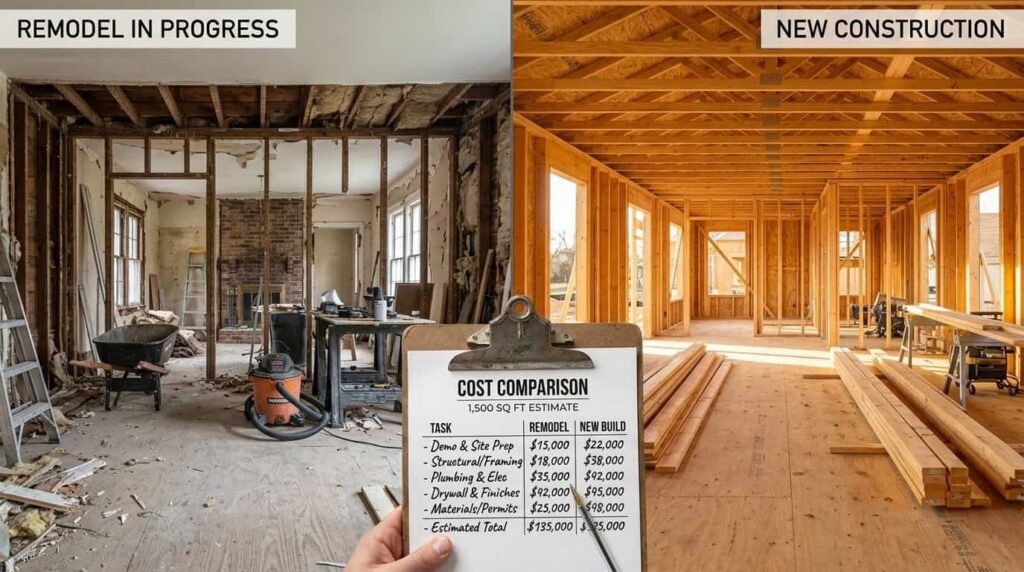
The remodel vs build new cost comparison almost always favors remodeling when the existing house has sound bones. Industry data shows renovations come in 30 to 50 percent less than comparable new builds in most cases, and remodeling wins on cost roughly 80 percent of the time. A whole-home remodel typically runs $80 to $250 per square foot depending on scope, while a custom new build runs $200 to $400 or more per square foot once you include the lot, site work, and soft costs. That gap exists because remodeling preserves the foundation, framing, roof structure, and utility connections, which together represent 30 to 40 percent of a new home’s cost. Building new becomes the cheaper path only when the existing structure has failed or when the lot itself creates unusual constraints.
Per-Square-Foot Costs Side by Side
New construction pricing starts at roughly $150 per square foot and climbs past $400 for custom work, with most custom builds landing between $200 and $400 per square foot before land costs. A standard new custom home averages around $335 per square foot in many markets, which places a 2,000-square-foot build near $670,000 before site work and permits. Major renovations with structural changes run $150 to $300 per square foot, while full gut renovations run $150 to $400 or more depending on finishes. Light renovations cost far less at $80 to $150 per square foot. When you line up those ranges, the remodel vs build new cost question answers itself for most structurally sound homes: the renovation path costs less per square foot at every finish level except the most extreme custom tier.
Why Remodeling Usually Costs Less
Remodeling wins because it reuses what already exists. The foundation, exterior walls, roof framing, and utility connections represent the most expensive fixed costs in any project, and a remodel keeps them in place. A new build must pay for excavation, foundation work, framing, roofing, siding, and utility hookups from scratch, and those line items add up before a single finish material arrives. Renovation also shortens the timeline, which reduces carrying costs, temporary housing expenses, and financing interest. A whole-home remodel typically takes six to eleven months, while a tear-down and rebuild takes eleven to eighteen months from start to finish. Shorter timelines mean less disruption and lower soft costs, and those savings compound when the project requires a construction loan.
When Building New Becomes the Cheaper Choice
Building new makes sense when the existing house needs nearly everything at once. A failing foundation, severe layout problems that require moving most walls, or a structure that has suffered fire or water damage can push renovation costs past new construction pricing. A house with knob-and-tube wiring throughout, galvanized plumbing that has failed, and a roof at the end of its life forces a gut renovation that erases much of the cost advantage remodeling normally provides. New construction also wins when the lot itself creates constraints. A lot already cleared and serviced removes the site work premium that normally pushes new-build costs higher. In those cases, the remodel vs build new cost comparison tilts toward building because the renovation would essentially reconstruct the house inside the old shell.
The Hidden Costs on Both Sides
Every path carries costs that headline numbers miss. A remodel hides surprises inside walls, and opening a 1,500-square-foot house often reveals rotted framing, outdated wiring, or a plumbing stack untouched for decades. Those discoveries add thousands to the final invoice and extend the timeline. A new build hides costs in site work, permit fees, utility connections, and landscaping, which rarely appear in per-square-foot estimates. Tearing down the old house adds demolition and disposal costs that range from $8,000 to $30,000 in many markets. Architectural planning adds $3,000 to $20,000 before construction begins. Financing costs differ as well, since construction loans carry higher rates and shorter terms than renovation financing. Comparing sticker prices without those line items produces a misleading answer.
Timeline and Disruption Compared
A remodel keeps you in the house for part or all of the project, while a tear-down forces you to move out entirely. That difference matters financially. Temporary housing for twelve to eighteen months adds rent, storage, and moving costs that can exceed $30,000 in many markets. A remodel of a 1,500-square-foot home often allows phased occupancy, which reduces or eliminates temporary housing expenses. Construction timelines also affect financing costs. A shorter remodel timeline means fewer interest payments on a construction loan, and it reduces the risk of material price increases that occur during long projects. Homeowners who compare the remodel vs build new cost without accounting for timeline and disruption miss a major piece of the financial picture.
Permits, Zoning, and Lot Constraints
Zoning rules sometimes decide the question before cost enters the conversation. An older house that sits closer to lot lines than current rules allow can usually be kept and remodeled, because it holds legal nonconforming status. A new house on the same lot must meet today’s setbacks, which may force a smaller footprint or a different shape that reduces usable square footage. Floodplain rules create another wrinkle, since a remodel costing half or more of the building’s market value can bring the entire structure under flood regulations, which sometimes tips the decision toward rebuilding. Historic districts add review requirements that slow new construction and favor renovation. Before you compare dollar figures, confirm what the lot and the zoning code allow.
Financing and Resale Considerations
Renovation financing usually costs less than construction financing. Home equity loans and renovation mortgages carry lower rates than construction loans, and they require less paperwork. A new build on your own lot requires a construction loan that converts to a permanent mortgage after completion, and lenders scrutinize those projects closely. Resale value also differs. A remodeled home in an established neighborhood often appraises well because comparable sales support the investment, while an expensive new build in a neighborhood of modest homes may not recover its cost at resale. The remodel vs build new cost comparison should include the after-completion value, not just the construction invoice, because a cheaper project that fails to add resale value is not actually cheaper.
A Decision Framework for Homeowners
Answer four questions before choosing a path. First, is the foundation and frame sound? If yes, remodeling usually wins on cost. Second, does the layout work with moderate changes, or does it require moving most walls? Extensive layout changes erode the remodel advantage. Third, does the lot allow a new house that meets current setbacks and zoning rules? If not, remodeling may be the only permitted option. Fourth, how long can you live with disruption? A remodel that keeps you in the house saves money that a tear-down cannot recover. Homeowners who answer those questions honestly usually find that remodeling wins when the structure holds up, and building new wins only when the existing house has reached the end of its useful life.
Frequently Asked Questions
1. Is it cheaper to remodel or build a new house in 2026? Remodeling is cheaper in most cases, running 30 to 50 percent less than comparable new construction, because it preserves the foundation, frame, and utility connections.
2. What is the per-square-foot cost to build new versus remodel? New custom construction runs $200 to $400 or more per square foot, while a major remodel runs $150 to $300 per square foot and a light remodel runs $80 to $150.
3. How much does it cost to tear down and rebuild a house? Demolition alone costs $8,000 to $30,000, and new construction averages $150 to $450 or more per square foot depending on location and finishes.
4. When does building new become cheaper than remodeling? Building new wins when the foundation, wiring, plumbing, and roof all need replacement, or when the lot already sits cleared and serviced with utilities available.
5. How long does a remodel take compared with a new build? A whole-home remodel takes six to eleven months, while a tear-down and rebuild takes eleven to eighteen months from start to finish.
6. What hidden costs affect the remodel vs build new cost comparison? Remodels hide wall damage, wiring, and plumbing surprises, while new builds hide site work, permits, demolition, and landscaping costs that headline estimates often omit.
7. Do zoning rules affect whether I can remodel or rebuild? Yes. Older homes often hold legal nonconforming status that allows them to stay closer to lot lines than new construction would permit, and floodplain rules can push a large remodel toward rebuilding.
8. Which path offers better resale value? A remodel in an established neighborhood usually appraises well against comparable sales, while an expensive new build in a modest neighborhood may not recover its cost at resale.
9. Can I finance a remodel more cheaply than a new build? Yes. Home equity loans and renovation mortgages carry lower rates and simpler terms than construction loans, which reduces the total cost of the project over time.
10. What is the first step in deciding between remodeling and building new? Have a structural engineer or contractor assess the foundation, frame, and major systems. That assessment reveals whether the existing house can support a cost-effective remodel or whether its condition favors new construction.
Final Thoughts on Remodel vs Build New Cost
The remodel vs build new cost comparison favors remodeling whenever the existing structure holds up. Sound foundations, usable layouts, and serviceable mechanical systems make renovation the lower-cost path by a wide margin. Building new becomes the better choice when the house has failed structurally or when the lot itself removes the usual site-work premium. Compare total project costs including timeline, temporary housing, financing, and resale value before you decide, and let a structural assessment guide the final call rather than a per-square-foot average alone.